Technology that can adapt to the ever-changing needs of ESco.Technology=people, processes and tools
May / July 2022 · Ivan, Harmonic Action Technologies
Target Architecture
The external architecture review that opened the programme - an outside perspective on the existing stack, a recommended target model, and a roadmap for getting there.
Overview
In May 2022, ESco commissioned Ivan (Harmonic Action Technologies) to carry out an external review of the technology architecture and recommend how to evolve it for the next decade. This was the starting point for the whole programme.
The review brought an outside perspective on the existing stack, the strengths and weaknesses of Myriad, and the choices available for modernisation. It set the direction that Phase 1 then went on to test.
The review opened with a SWOT exercise across the existing stack and across Myriad specifically.
Across the stack
Strengths: customer-focused solutions, a dedicated business-aware team, strong planning and control, strong test and deployment, personalised customer service.
Weaknesses: a large number of homegrown tools, reliance on an outdated toolset, critical knowledge concentrated in individuals, reliance on Myriad and Isle, Myriad not being actively developed.
Opportunities: move to a cloud-first model, upgrade and reinvigorate Myriad, leverage the Microsoft Power Platform, empower the team, integrate with other publishing systems.
Threats: SaaS platform bureau services, customers expecting faster feature turnarounds.
On Myriad
Strengths: robust core database model, suitably tailored for the industry.
Weaknesses: a separate instance per customer, no modern web UI, dated VB.NET WinForms front-end, on-premises hosting, reliant on embedded stored procedures, no shared product roadmap.
The review also looked at an "All-in with Microsoft" reference architecture (full D365 and Power Platform) and discounted it - the disruption to achieve it would be significant, knowledge would have to be rebuilt, and it ignores the bureau model where ESco needs to facilitate and integrate with a range of customer technologies.
Architectural target model
The recommended architecture has three key components:
Maintaining an evolved Myriad core database
Phasing out legacy on-premises tools in favour of modern Microsoft development and data manipulation tools and platforms
Opening up processes to integrate with other systems
The high-level model:
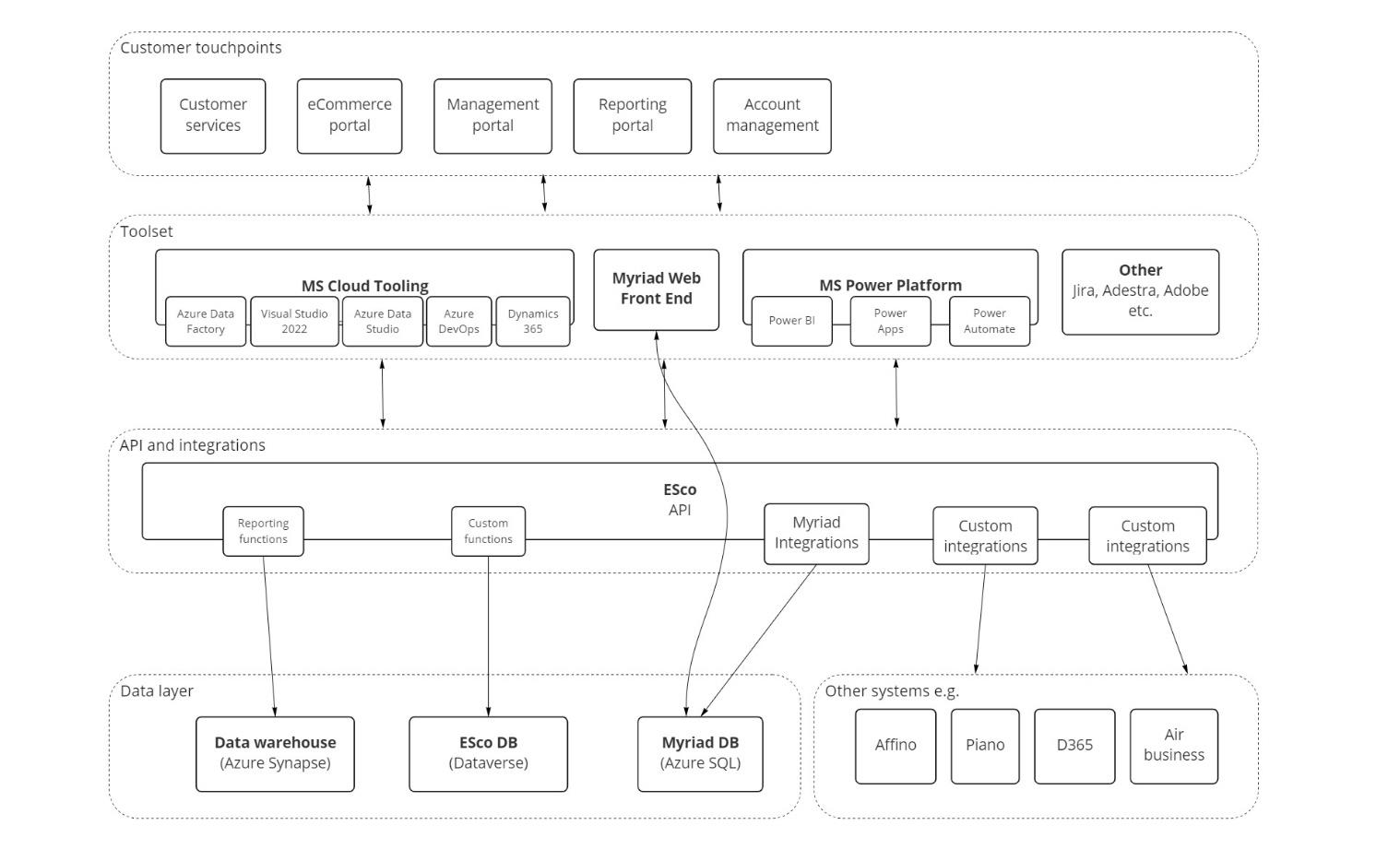
Myriad - upgraded with a web interface and cloud data management
Cloud - infrastructure and services cloud-based where possible
ESco API layer - abstracted to encompass Myriad API functions and connections to other systems over time
ESco tooling - Access-based on-premises tools upgraded to make use of Azure and Power Platform cloud-based tools
Customer touch points - eCommerce, reporting, and management applications running from cloud SaaS services and / or MS Power Platform tooling
The eCommerce portals are not changed specifically in this model, though ESco should plan to move away from Isle's bespoke CMS over time, decoupling the Myriad / Isle integration into a more flexible architecture.
Figure 5 from the review: the upgraded approach. Customer touchpoints, an MS Cloud / Power Platform toolset, the ESco API layer, and a data layer with Myriad alongside the ESco DB and data warehouse.
Recommended principles
Core technology principles to guide decisions and hold fast to the vision.
Design for the cloud. Previous concerns about moving to the cloud should be reviewed and revisited.
Keep everything up to date. It is a false economy to save money by staying on old versions. Staying current is key to staying secure and compliant.
DRY. Don't repeat yourself - for example, multiple Myriad instances per customer.
Favour the Microsoft option first. When faced with technology choices, choose the MS option where possible.
Keep it simple. Prioritise simplicity and maintainability over complexity and bespoke solutions.
Design for change. Expect and welcome future change.
These are recommendations - the final set of principles must be agreed in a workshop with the technology team. They have to be owned by the team for them to be effective, and once agreed they should be followed closely.
Migration roadmap
A migration roadmap, recognising that change at this scale cannot be achieved in one leap. ESco and the technology team should explore and migrate systems forward across the following areas:
From
To
Managed infrastructure
Software as a Service (cloud)
Stored procedures
An embedded logic model
Replicated systems (Myriad per client)
Centralised master
Access DB
Power Platform tools
SOAP APIs
REST, MS Graph, GraphQL
VB.NET / .NET Framework
.NET 5/6 and C#
SSRS
Power BI
SSIS
Azure Data Factory
Customer portals
MS Power Pages
SQL Server
Dataverse or Azure SQL
For Myriad specifically, to remain competitive long-term it should: move the backend to cloud hosting (e.g. Azure SQL); add all its primary keys and clustered indexes; refactor the database design to allow proper customer segmentation; rebuild the front-end with modern web technologies; and upgrade the API from SOAP to REST or GraphQL where appropriate.
Business impact by area
How the proposed direction affects each main business service area.
Renewals and Comms. A lot of this could be managed in Dynamics 365, abstracting it from Myriad specifically and enabling a broader set of supported platforms.
Customer Service and Finance. Maintaining a high level of customer service is vital - these processes should have minimum disruption. If new Myriad interfaces are developed, the CS team should be fully involved as key users. Dynamics 365 could manage finance processes to abstract them from Myriad.
Fulfilment and production. Changes depend on process changes within newly adopted platforms.
Analytics and Insight. Standardise on platforms that promote self-service (e.g. Power BI). Data sources should be abstracted so the reporting platform is not tightly coupled to Myriad.
eCommerce. ESco should be able to support white-label eCommerce solutions without tight reliance on Myriad integrations. The Myriad API should be abstracted into a generic ESco API, in turn integrable with standard eCommerce solutions. This enables moving away from Isle's custom CMS.
Single Customer View. A Master Data management model is required. Key decision: does ESco maintain the master record for a customer, or does it remain in a third-party platform?
Web content creation. Standardise on off-the-shelf tools rather than Isle's bespoke CMS.
Integration and API. Grow with a modern toolset and become a more significant component of ESco's value offering.
Potential risks
Risk
Impact
Likelihood
Mitigation
Myriad is not saveable
High
Medium
Scrutinise roadmap, do due diligence on Gordon and Gotch
Resistance to change
Medium
Medium
Keep communicating, take time to align
Transformation costs and efforts too great
High
Medium
Work iteratively to reach value milestones, continually review strategy
ESco loses its personal touch with customers
High
Low
Prioritise customer service layer functioning independently of architecture changes
Change not rapid enough to maintain competitive advantage
 Tech Transformation