 Tech Transformation Tech Transformation
 Pivoted
Could we build a hybrid, adaptable infrastructure, the Harbour and Crane, to process data specifically for the Single Customer View product, and in doing so prove the CRM-agnostic approach that Phases 1 and 2 pointed towards?
We set up Google Cloud Platform (GCP) and MongoDB cloud environments and designed two core components:
The intended use case was the Single Customer View product, which uses Orbit (Apteco) to present a consolidated view of subscriber data drawn from multiple sources. The environments were stood up and the architecture designed, but the full SCV proof of concept was not completed before SCV was paused in July 2025.
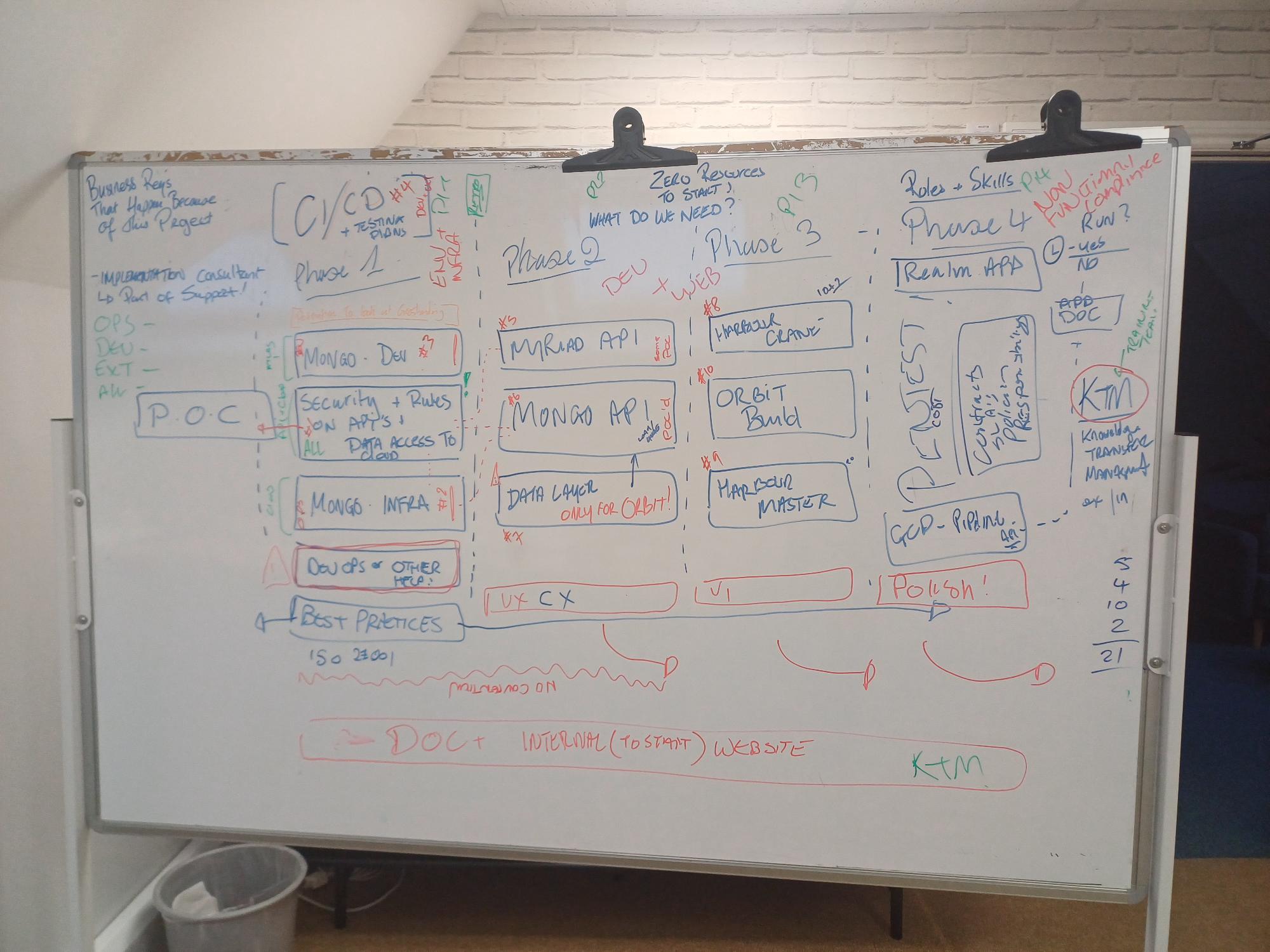
GCP and MongoDB environments were configured and functioning. The Crane and Harbour pattern was designed and the infrastructure was in place — but the full SCV proof of concept was not completed. Phase 3 got the environments ready; the POC work happened in Phase 4 against different use cases.
It also became apparent that the market appetite for the Single Customer View service was not strong enough to justify ongoing, exclusive investment. The commercial case for SCV as a standalone product did not hold up.
Phase 3 ran from late 2023 through to July 2025. At that point, two factors prompted a pause rather than a full pivot:
SCV was paused while the team spent the summer and autumn of 2025 running a broader proof of concept, exploring whether the middle layer architecture could support other use cases beyond SCV. Two micro services were chosen as test cases: Books/Backs and Comm Docs (Commercial Documents). That work validated the approach at broader scope.
At the end of 2025, the decision was made to apply the architecture to a specific, high-value user need: promo code creation. Phase 4 began in December 2025.
The central objective of the architecture is to ensure ESco is not locked to Myriad, or any single CRM. By making backend systems interchangeable, ESco dramatically reduces vendor lock-in risk. If a new client wants to use their own CRM, or if ESco decides to replace Myriad entirely, the core microservices continue to function without a complete system rebuild.
This matters because the acquisition of Gordon and Gotch (the company behind Myriad) by Intermedia created genuine uncertainty about Myriad's long-term roadmap and pricing. The architecture is designed so that Myriad can be swapped out, or supplemented, without disruption to the systems around it.
The intermediary tool built to extract, receive, transform, and load data. Acts as the universal translator between the CRM and the microservices. ESco is currently evaluating whether to continue building this in-house or procure an iPaaS.
The central data repository, built on MongoDB. Initially used in Phase 3 as a static data warehouse with a flexible schema. In Phase 4, repurposed to act as a process queue system.
Independent services (such as Aimee, eCommerce, document generation) that interact with the Harbour. Designed to be replaceable and independent of the core CRM.
Chosen to host the new architecture, including API endpoints and AI integrations, shifting ESco away from on-premises servers.
Data processing is bi-directional. The flow works as follows:
This replaces the old approach of manual or scheduled polling, where systems were checked periodically rather than updated in real time.
The integration layer relies on an ESco API and webhooks. Webhooks allow the architecture to respond to real-time events in the CRM rather than batch-processing data on a schedule. This is a significant shift from how ESco systems historically operated and is central to making the architecture scalable and responsive.
MongoDB as a queue system. External consultants flagged that document databases are not naturally optimised for high-throughput queueing semantics. The internal team accepted this risk and proceeded with MongoDB to maintain momentum, noting that the underlying tools can be swapped out if the proof of concept validates the approach but MongoDB buckles under production queue loads.
Build or buy for the Crane. Whether ESco builds the ETL/RTL Crane entirely in-house or procures an external iPaaS platform is still unresolved and sits as an open procurement decision.